
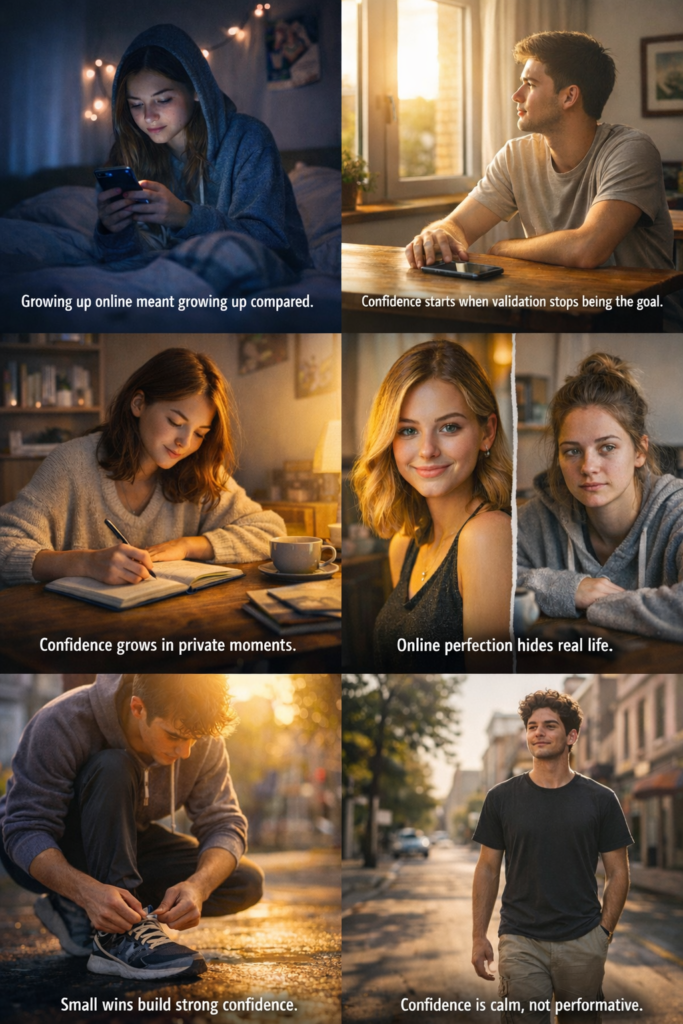
Growing up online changed everything—how we see ourselves, how we compare, and how we define confidence. For Gen-Z, confidence isn’t just about walking into a room with your head held high. It’s about surviving algorithms, filters, likes, trolls, and constant comparison—and still believing you’re enough.
If you grew up online and struggle with confidence, you’re not broken. You’re responding normally to an abnormal environment. Here’s how to rebuild confidence in a digital-first world.
1. Understand Why Confidence Feels Harder for Online Kids

Gen-Z didn’t just use the internet—we grew up inside it.
From a young age, we were exposed to:
- Curated lives on Instagram
- Viral success stories at 16
- Beauty filters that quietly rewired self-image
- Public opinions on private moments
Confidence used to grow in small, local circles. Now it’s shaped by global comparison.
Key truth: Your insecurity isn’t personal failure—it’s environmental conditioning.
2. Separate Your Worth From Online Validation

Likes, views, replies, and followers feel harmless—but they slowly teach us that attention equals value.
Real confidence begins when you stop outsourcing self-worth to:
- Engagement metrics
- Viral moments
- Other people’s opinions
Try this:
- Post less, observe more
- Create without checking reactions immediately
- Ask: Would I still like this if nobody saw it?
Confidence grows when approval becomes optional, not necessary.
3. Rebuild a Real Relationship With Yourself

Online life trains us to perform, not to feel.
To rebuild confidence, you need moments where:
- No one is watching
- No one is judging
- No one is rating you
Simple but powerful practices:
- Walk without headphones
- Journal without planning to post quotes from it
- Try hobbies you’re bad at and keep doing them anyway
Confidence isn’t loud—it’s familiarity with yourself.
4. Stop Comparing Your Behind-the-Scenes to Their Highlights
Online confidence killers usually sound like:
- “Everyone else is ahead”
- “I’m wasting time”
- “I should be doing more”
But what you’re seeing is edited success, not full reality.
Remember:
- You’re comparing your confusion to someone else’s best angle
- Growth isn’t linear—even if social media makes it look that way
- Offline progress doesn’t always photograph well
Confidence comes when you trust your timeline.
5. Build Confidence Through Small, Offline Wins
You don’t need a “glow-up.” You need proof.
Real confidence is built through evidence, not affirmations:
- Keeping promises to yourself
- Finishing small tasks
- Showing up consistently
Examples:
- Working out for 10 minutes
- Reading 5 pages a day
- Speaking up once in a meeting/class
Tiny wins compound into quiet confidence.
6. Redefine What Confidence Actually Means
Online culture sells confidence as:
- Being loud
- Being aesthetic
- Being fearless
But real confidence looks like:
- Saying “I don’t know”
- Setting boundaries
- Not explaining yourself
- Choosing peace over performance
Especially for Gen-Z, confidence doesn’t mean hustling harder—it means living more honestly.
7. You’re Not Late—You’re Just Offline With Yourself
If you grew up online, learning confidence might take longer—but it’ll be deeper.
You’re unlearning:
- Constant comparison
- Digital perfection
- External validation
And learning:
- Self-trust
- Presence
- Inner stability
That’s not weakness. That’s evolution.
Final Thought
Confidence isn’t something you download, post, or go viral for.
It’s something you build—slowly, quietly, offline.
And for a generation raised online, choosing yourself might be the most confident move of all.